
IDEAL TASTING CONDITIONS
As is the case for many products of exceptional quality, the basis of perfect tasting depends on the quality of the ritual of preparation.
Your fresh or semi-cooked Georges Bruck foie gras should be kept in the refrigerator. If you have chosen a product from our range of foie gras conserves, we recommend that you keep it in the refrigerator for several hours before tasting it.
First of all, when you are getting ready to begin preparation of your foie gras, remember to keep an eye on the temperature. To cut your foie gras into good 7 to 8 mm thick slices, the temperature of your product should be between
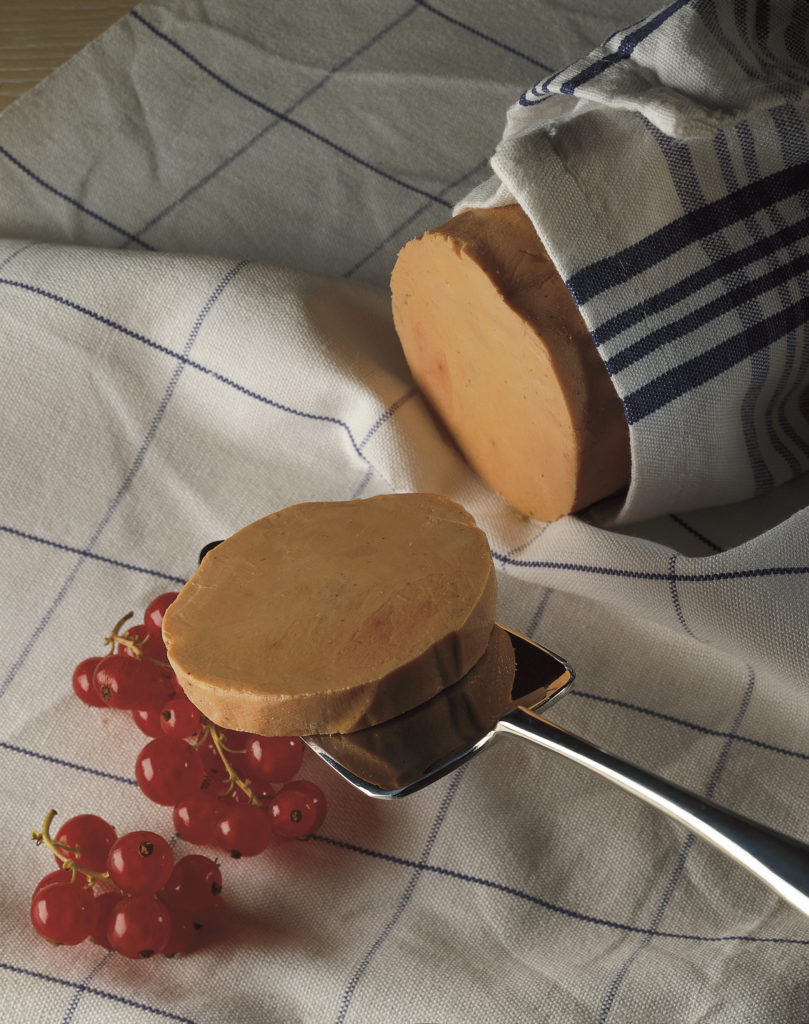
4° and 6°. Use the blade of a knife, heated in hot water, or a lyre (wire cutter) and repeat this ritual between each slice. Then put it back into the refrigerator and take out 5 to 10 minutes before serving. If your foie gras is presented in a terrine dish, serve it with a spoon that you have first soaked in hot water. Or remove it from its mould: to make this easier, immerse the foie gras container (jar or tray) very briefly in hot water.
General observations
Don’t spread a Georges Bruck foie gras, eat it with a fork and without a knife! Cut up the foie gras with a fork, put it in your mouth, and add a piece of bread if you wish. “Strasbourg Foie Gras” is at home with festive table cutlery and eaten with a fork.
Foie gras should be served on very cold plates. Take it out of the refrigerator 5 to 10 minutes before serving. As a starter, we advise you to serve 50 to 70 g per person. Do not serve it with drinks or food with too strong a taste, such as spirits or savoury snack biscuits. Do not combine it with the acidity of a dressed salad.
Foie gras should be served on very cold plates. Take it out of the refrigerator 5 to 10 minutes before serving. As a starter, we advise you to serve 50 to 70 g per person. Do not serve it with drinks or food with too strong a taste, such as spirits or savoury snack biscuits. Do not combine it with the acidity of a dressed salad.
Suggested Alsatian wine pairings
The following wines are greatly appreciated: Gewurztraminer, Pinot Gris, Riesling, grand vintage wines, providing character and substance. Depending on their local terroir and the winegrower’s skill, the wines may be distinguished by the complexity of their aromas – floral, spicy and/or fruity with notes of candied and overripe fruit. Structure and sweetness are also qualities that must be taken into account.
We may also choose a contrast by serving a white, mineral, slightly acidic wine, such as an Alsace Riesling. Its fresh taste contrasts with the fatty flavour of the terrine but does not overpower it. Traditionally, white Alsace liqueur wines (Late Harvest or Sélection de Grains Nobles) are recommended with foie gras because of their aromatic complexity, structure and nose, a magnificent match for its richness. The fondant texture of foie gras demands a fleshy, dense white wine that nevertheless has an attractive freshness, enriched with complexity. Ideally, a wine with a few years’ maturity will alternate between the freshness of its fruit
We may also choose a contrast by serving a white, mineral, slightly acidic wine, such as an Alsace Riesling. Its fresh taste contrasts with the fatty flavour of the terrine but does not overpower it. Traditionally, white Alsace liqueur wines (Late Harvest or Sélection de Grains Nobles) are recommended with foie gras because of their aromatic complexity, structure and nose, a magnificent match for its richness. The fondant texture of foie gras demands a fleshy, dense white wine that nevertheless has an attractive freshness, enriched with complexity. Ideally, a wine with a few years’ maturity will alternate between the freshness of its fruit


Pairing with other wines
The combination of a great white Burgundy (Meursault, Pouilly-Fuissé) and foie gras adds character to the softness. A smooth, sparkling Champagne of excellent lineage. A dark grape white wine produced from the Pinot Noir grape is the best choice. It will be less acidic than a white Champagne produced from a light-skinned grape. Pairing with an older vintage red Bordeaux wine, in which the tannins have softened and matured (Médoc, Saint-Émilion, Cahors, Médoc or Haut-Médoc Cru Bourgeois, Haut-Médoc Classified Grands Crus, Graves, Rive droite…) or even a Port, may prove to be perfect with a truffled goose foie gras. The melting texture of the foie gras demands a fairly dense, mellow red wine capable of melting into its texture.
Nevertheless, the tannins must be softened to reveal a fine, comfortable persistence.The finely spiced sensation, the softened tannins and the resulting maturity (aided by the woodiness) will provide a remarkable combination with the texture of the foie gras. The richness of the foie gras will soften the strength of the wine, without losing its own flavour. Chutney and gingerbread should be avoided: the combined powerful taste of the wine and the strength of the spices will cover the taste of the foie gras. A special mention should be reserved for Irouléguy, the Basque country wine that may be served with pan-seared foie gras.
Nevertheless, the tannins must be softened to reveal a fine, comfortable persistence.The finely spiced sensation, the softened tannins and the resulting maturity (aided by the woodiness) will provide a remarkable combination with the texture of the foie gras. The richness of the foie gras will soften the strength of the wine, without losing its own flavour. Chutney and gingerbread should be avoided: the combined powerful taste of the wine and the strength of the spices will cover the taste of the foie gras. A special mention should be reserved for Irouléguy, the Basque country wine that may be served with pan-seared foie gras.
Bread pairings
The choice of bread, like that of the wine, is also of considerable importance. Farmhouse yeast-leavened bread, or even good sliced bread, will provide a perfect combination with the rustic flavours of duck foie gras, whilst the subtler flavours of goose foie gras will be a perfect combination with brioche bread. If you choose a fairly dense crumb and a nice crunchy crust, you will appreciate the flavours but also the texture of your foie gras all the more. In addition to this, the crustiness will perfectly combine with the softness of this product.
Farmhouse bread: lightly toasted. Brioche bread: lightly toasted.
White bread: lightly toasted and crunchy.
Gingerbread: for an exciting touch, place a slice of foie gras on a thin slice of gingerbread. The flavours of this bread are a perfect match for this product and will bring it into its own.
Walnut bread: Absolute boldness: brush a few drops of balsamic vinegar onto each slice of plain foie gras and add a finely chopped rocket leaf. Then put it onto a very lightly toasted slice of walnut bread.
Farmhouse bread: lightly toasted. Brioche bread: lightly toasted.
White bread: lightly toasted and crunchy.
Gingerbread: for an exciting touch, place a slice of foie gras on a thin slice of gingerbread. The flavours of this bread are a perfect match for this product and will bring it into its own.
Walnut bread: Absolute boldness: brush a few drops of balsamic vinegar onto each slice of plain foie gras and add a finely chopped rocket leaf. Then put it onto a very lightly toasted slice of walnut bread.


Pairings with fruit, spices and other Combinations
Jelly was traditionally used to conserve foie gras and prevent it from oxidising. It must be kept in the refrigerator for 24 hours before tasting and comes in small cubes, crushed or served with a spoon. Georges Bruck jelly is produced according to a traditional recipe, from Muscat, Madeira or Port. For decoration and presentation on a plate, although Georges Bruck foie gras is itself sufficiently seasoned and spicy, the following may be used with foie gras:
- Matured balsamic vinegar syrups.
- Peppers: a great friend of foie gras, since they give it a sharp, acidic touch. Examples: Sarawak, Cubeb, Java pepper, white Penja pepper…
- Salt: sea salt crystals, whose iodine taste is ideal seasoning for a slice of foie gras and whose crystals add an attractive contrast to the velvety texture of the foie gras. Blue Persian salt, pink Himalayan salt. :
- Fruit: dried or fresh.

